Wednesday, February 3, 2016

Amino Wants to Bring Bioengineering to Your Workbench

Amino Wants to Bring Bioengineering to Your Workbench


Amino Wants to Bring Bioengineering to Your Workbench

As the maker movement has exploded in popularity in recent years, there has been a strong push to put industrial tools into the hands of amateur tinkerers and hackers. CNC mills, 3D Printers, and laser cutters were all extremely expensive machines that were far too costly for most people until makers demanded them and hackers found ways to make them affordable. But, aside from the home brewing scene, those advancements haven’t really touched on anything organic. Which is a deficiency that Amino, a desktop bioengineering system, is seeking to address.
Amino, created by [Julie Legault], is currently seeking crowd-funding via Indiegogo. Hackaday readers are more suspicious than most when it comes to crowd-funding campaigns, and with good reason. But, [Julie Legault] has some very impressive credentials that lend her a great deal of credibility. She has four degrees in the arts and sciences, including a Masters of Science at the MIT Media Lab.
It was for that degree at MIT that [Julie] started Amino as her thesis. Her plan is to bring the tools necessary for bioengineering to the masses – tools which are traditionally only available in research labs. Those tools are packaged into a small desktop-sized unit called Amino. Backers will receive this desktop system, along with the supplies for their first project. Those projects are predefined, but the tools are versatile enough to allow users to move on to their own projects in the future. [Julie] thinks that the future is in bioengineering, and that the best way to feed innovation is to make the necessary tools both affordable and accessible.

IndieGoGo Project Offers DNA Editing For The Home

IndieGoGo Project Offers DNA Editing For The Home


IndieGoGo Project Offers DNA Editing For The Home

CRISPR is the new darling of the genetics world, because it allows you to easily edit DNA. It is far more effective than previous techniques, being both precise and relatively easy to use. According to this IndieGoGo project, it is coming to your home lab soon. Genetic researchers love Clustered Regularly Interspaced Short Palindromic Repeats (CRISPR) because it allows you to very precisely edit a DNA strand. Using a protein called CAS9, CRISPR can find a very specific sequence in a DNA sequence and cut it. It occurs naturally in cells as part of the immune system: by finding and remembering parts of virus DNA, a cell can recognize and attack it when infected. For the genetics researcher, this allows them to insert new DNA sequences at specific points in the genes of any living cell.

The IndieGoGo project is set up by Dr Josiah Zayner, who works as a Postdoctoral Researcher at the NASA Ames Research Center. In his spare time, he runs a site called The ODIN (or the Open Discovery Institute) that helps genetic researchers collate and share their work. The IndieGoGo project is an offshoot of that, and for $130, it is offering everything you need to edit the DNA of bacteria so they can survive on a new food source. Add another $20 and you get the ability to edit the DNA of yeast so that they turn red.
That might sound trivial, but the idea here is intriguing. In the accompanying video, Dr Zayner says that “As a single scientist, I can only accomplish so much. I began to think: what if the scientific population of the world doubled? What if the lab I had at NASA could be found at a kitchen table?” In effect, he is trying to throw the doors of the world of genetic editing open to all. As Zayner puts it, “If you had access to synthetic biology tools, what would you create?”.


Basic Toolkit for the Basement Biohacker

Basic Toolkit for the Basement Biohacker


Basic Toolkit for the Basement Biohacker

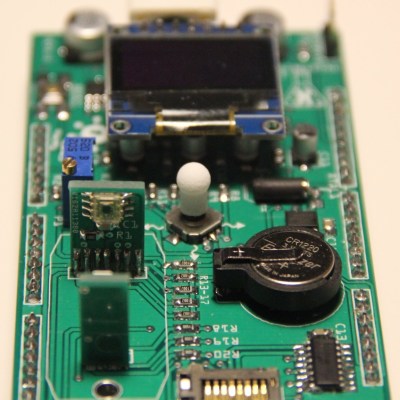
Laying hands on the supplies for most hacks we cover is getting easier by the day. A few pecks at the keyboard and half a dozen boards or chips are on an ePacket from China to your doorstep for next to nothing. But if hacking life is what you’re into, you’ll spend a lot of time and money gathering the necessary instrumentation. Unless you roll your own mini genetic engineering lab from scratch, that is.
arduino-based-biolab-data-logger-thumbTaking the form of an Arduino mega-shield that supports a pH meter, a spectrophotometer, and a PID-controlled hot plate, [M. Bindhammer]’s design has a nice cross-section of the instruments needed to start biohacking in your basement. Since the shield piggybacks on an Arduino, all the data can be logged, and decisions can be made based on the data as it is collected. One example is changing the temperature of the hot plate when a certain pH is reached. Not having to babysit your experiments could be a huge boon to the basement biohacker.
Biohacking is poised to be the next big thing in the hacking movement, and [M. Bindhammer]’s design is far from the only player in the space. From incubators to peristaltic pumps to complete labs in a box, the tools to tweak life are starting to reach critical mass. We can’t wait to see where these tools lead.


The Three Main Clouds - Cirrus, Stratus, Cumulus

The Three Main Clouds - Cirrus, Stratus, Cumulus


Weather 101: A Tutorial on Cloud Types


Wednesday, March 25, 2015

Θερμό μήνυμα στήριξης της Ελλάδας


Θερμό μήνυμα στήριξης της Ελλάδας και του λαού της στέλνει ο Αμερικανός πρόεδρος Μπαράκ Ομπάμα, με την ευκαιρία της 25ης Μαρτίου.
Μεταξύ άλλων αναφέρει ότι σήμερα, καθώς η Ελλάδα εργάζεται να τεθούν οι βάσεις για μακροπρόθεσμη ευημερία, «το έθνος μας συνεχίζει να υποστηρίζει τη φίλη και σύμμαχό μας στο ΝΑΤΟ και να βοηθήσει τον Ελληνικό λαό να φτάσει σ' ένα μέλλον που τόσοι πολλοί αναζητούν: ένα μέλλον όπου όλοι, γυναίκες και άνδρες, είναι ελεύθεροι να ακολουθήσουν τα όνειρά τους».